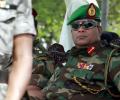
Silva's name was mentioned in the resolution passed by the UN Human Rights Council (UNHRC) in 2013, alleging rights abuses by the Sri Lankan Army.

The Chinese have only created limited defences for protection of their posts which are located well in depth and much away from the Line of Actual Control, notes Colonel S Dinny (retd).

Six Army personnel including Col Santosh Babu, Nb Sub Nuduram Soren, Hav K Palani, Hav Tejinder Singh, Nk Deepak Singh and Sep Gurtej Singh, who lost their lives in the Galwan valley clash, have been awarded Chakra series wartime gallantry medals posthumously.

China is the second largest spender on defence after the US. T
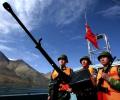
The Chinese side has particularly bolstered its presence in the Galwan Valley, erecting around 100 tents in the last two weeks and bringing in heavy equipment for construction of bunkers, notwithstanding the stiff protest by Indian troops. There have been reports of multiple incidents of transgressions by Chinese troops in several areas in Eastern Ladakh.

The Army has also further bolstered overall surveillance mechanisms in all areas along the Line of Actual Control (LAC) in eastern Ladakh after foiling China's fresh attempt to occupy an area on the southern bank of Pangong lake, they said.
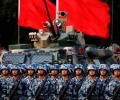
The statements come from a booklet published this month by the state-run People's Publishing House, in which senior officials, including President Xi, outlined the latest five-year plan for the country's development.
In all likelihood, the next conventional Chinese attack on India would be preceded by a massive cyber attack designed to cripple Indian networks and interfere with our disaster-relief programmes.
The new law, effective from January 1, weakens the role of the State Council, China's Cabinet headed by Premier Li Keqiang, in formulating military policy, handing decision-making powers to the Central Military Commission (CMC), the overall high-command of the two million-strong People's Liberation Army (PLA) headed by Xi, Hong Kong-based South China Morning Post reported on Sunday.

'Chinese troops are not geared to fight Indian troops who are battle hardened and acclimatised and are far more hardy.'

Sources indicated that during Saturday's talks, India will insist on a faster disengagement process in remaining areas to bring down tension in the region, which has witnessed a tense standoff between the two militaries for over nine months.
'They have done in Eastern Ladakh what we did in Dokalam in 2017.'

'However, a lot of preparatory work would have to go in and China must be prepared to announce an end to the standoff by disengaging from the remaining areas along the LAC.'

'We can expect heightened belligerence from China.'

The fourth edition of the India-China joint training exercise Hand-in-Hand 2014 kick-started on Monday at the Aundh Military Cantonment in Pune.
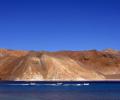
"As regards reports about a bridge being made by the Chinese side on Pangong Lake, the government has been monitoring this activity closely," External Affairs Ministry Spokesperson Arindam Bagchi said.
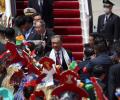
Wang Yang and Xi Jinping's visits signal the beginning of a major Chinese push to bring about a transformation of Tibet, observes Jayadeva Ranade, the distinguished China expert and retired RA&W officer.
'This reluctance to respond forcefully to Chinese PLA provocations and outright aggression has as much to do with Prime Minister Modi personally, as with the institutional mindset of the MEA or even the Indian Army.' 'They are scarred by the 1962 War and are still cowed by China.'

Both sides have completed creation of a buffer zone of three kilometres in the three friction points of Galwan Valley, Gogra and Hot Springs as part of a temporary measure aimed at reducing the possibility of any confrontation.

Narrowing of differences on competing territorial claims along the un-demarcated LAC might take weeks, if not months, of hard-nosed negotiations. Without some give and take on both sides, the impasse will be hard to resolve, observes Virendra Kapoor.

'An all-out war affects the whole nation.'

China remains in firm control of an estimated 600-800 square kilometres of Indian territory.

Naga splinter groups impatient with stalled talks as well as rebel Manipuri groups who have a stake in disrupting upcoming elections to the state assembly, are believed to be regrouping in the borderlands of China's Yunnan province and Myanmar, taking advantage of the turmoil in the latter by using it as a transit corridor.

'It is because of the bravery of Colonel Santosh Babu and his men that we have not seen a violent escalation anywhere else along the LAC.'

Taiwan considers itself a sovereign state -- but China views the self-ruled island as a breakaway province. Beijing has not ruled out the possible use of force to achieve unification.

According to official sources, the primary objective of Wei's visit is to deliberate with Indian defence establishment on implementation of decisions taken by Modi and Xi in their informal summit in Wuhan in April.

The sources also said another round of military talks between the two sides on Wednesday to defuse tensions in the area remained inconclusive. The talks lasted nearly seven hours.
During the course of the intense and complex negotiations between senior commanders of the two armies that ended at 2 am on Wednesday, the Indian delegation also apprised the Chinese PLA about the "red lines" and conveyed that the onus was largely on China to improve the overall situation in the region, the sources said.

The fifth edition of the joint exercise between Indian and China, codenamed 'Hand-in-Hand 2015', commenced at the Kunming Military Academy at Yunnan Province in China on October 12.

'The Ladakh clashes are mere warning signals of the storm to come on May 22 when the Chinese parliament meets,' observes Colonel Anil A Athale (retd).

A US RC-135S reconnaissance aircraft on Wednesday flew near the ongoing Chinese People's Liberation Army (PLA) drills in the South China Sea, a day after another US spy plane, a U-2, trespassed into another PLA exercise restricted zone, state-run Global Times reported.
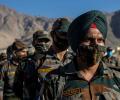
The decisions were mentioned in a joint statement issued by the two armies late Tuesday, a day after the sixth round of Sino-India Corps commander-level talks that lasted for 14-hours.

The formal process of disengagement of troops began on July 6, a day after a nearly two-hour telephonic conversation between National Security Advisor Ajit Doval and Chinese Foreign Minister Wang Yi on ways to bring down tensions in the area.

The paper also includes musing that SARS -- which hit China in 2003 -- could have been a man-made bioweapon deliberately unleashed by "terrorists".
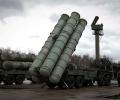
RInstead of disengagement, the Indian and Chinese armies have deployed an estimated 35,000 to 40,000 soldiers each along the LAC. The PLA has deployed S-400 air defence missiles to neutralise the IAF's advantage in air power

'Clarifying that modernisation of national defence and armed forces should be completed by 2035, Xi Jinping asserted the goal is to make the People's Liberation Army a "world class force" that "can fight and win" by 2050,' points out former RAW officer Jayadeva Ranade.
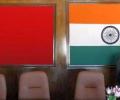
As the border standoff entered the sixth month, an early resolution to the row appeared dim with close to 100,000 Indian and Chinese troops remaining deployed in the high-altitude region and showing readiness for a long-haul. There is no official word on the talks yet but sources said the agenda was to finalise a roadmap for disengagement of troops from all the friction points.
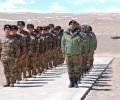
There was no comment from the Indian side on the statement made by the Chinese defence ministry spokesperson Colonel Wu Qian, and carried by China's official media.

The ministry's year-end review is silent on the continued occupation by Chinese troops of territory that India has always claimed and patrolled.
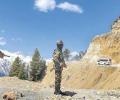
'India is not going to accept whatever the Chinese say. That is not going to happen.'
 © 2026 Rediff.com - Advertise with us - Disclaimer - Privacy Policy - Sitemap - Feedback - About us - Terms of use - Grievances